




Inside Fortune East Stone: A Factory Tour of Precision, Protection & Presentation
Walk into any cemetery, and you will see rows of quiet memorials standing in silence. What you will not see is the journey each tombstone took before arriving at its final resting place. That journey begins inside our factory at Fortune East Stone. We recently turned on the cameras to show you exactly how raw granite transforms into a finished grave stone. This article walks you through that video step by step. No marketing fluff. Just the real motions of a working tombstone factory. Every tombstone we make passes through every station you are about to read about.
 Video<< Showing our factory+ Polishing machine.mp4
1. A Full Factory Walkaround – Seeing Where Every Tombstone Begins
The video opens with a slow, continuous shot of our production floor. This is not a curated corner. This is the entire facility. You will see rows of granite blocks in different stages of completion. Some are still rough slabs fresh from the saw. Others have already taken the shape of a headstone. In the background, finished tombstones stand wrapped and waiting for shipment. Every tombstone on our floor has a path. Every path starts here.
Why show the whole factory? Because trust begins with transparency. A cemetery monument is not an impulse purchase. Families invest time, emotion, and money into a granite headstone. They deserve to know where their chosen tombstone comes from. Our factory walkaround proves one thing: we do not outsource critical steps to unknown subcontractors. Every tombstone you see on our website passes through this floor. Every edge, every surface, every package travels through these aisles. That is the promise behind every tombstone we ship.
As the camera pans, notice the organization. Raw material zones stay separate from machining areas. Machining areas stay separate from packing and shipping. This layout prevents cross-contamination of dust and reduces handling damage. A well-organized factory produces a well-made tombstone. It is that simple. A clean floor makes a clean tombstone. Your tombstone deserves that environment.
2. Machine Polishing – Where a Rough Slab Becomes a Tombstone
The first major action in the video shows our automatic polishing line. A rough-cut granite slab enters the machine on a roller bed. Water sprays continuously to cool the surface and suppress dust. Then the polishing heads begin their work. This is the moment a raw piece of granite starts its journey toward becoming a finished tombstone.
Each head carries diamond-impregnated pads of increasing fineness. The first head uses a coarse 30-grit pad. This removes the deep saw marks and makes the surface flat. The second head moves to 200-grit. The stone starts losing its rough texture. The third and fourth heads use 400-grit and 800-grit pads. By this point, the granite begins to reflect light. The final heads use 1500-grit and 3000-grit pads. When the slab exits the machine, the surface looks like dark glass. That slab is now ready to become a premium tombstone.
Why does this matter for a grave stone? A cemetery tombstone faces rain, frost, sun, and pollution. A rough surface traps moisture and dirt. Over years, that trapped moisture freezes and expands, causing microscopic cracks. A properly machine-polished tombstone resists water penetration because the surface is too smooth for water to grip. Machine polishing is not cosmetic. It is the first line of defense for any long-lasting tombstone. A polished tombstone is a durable tombstone.
The video shows our operator checking every slab immediately after polishing. He runs his palm across the surface. He tilts the slab toward an overhead light. Any missed spot goes back through the machine. No exceptions. Every tombstone deserves that level of attention. A rushed tombstone is a regretted tombstone. We do not rush.
3. Semi-Finished Tombstone Blanks – The Silent Inventory of Every Tombstone
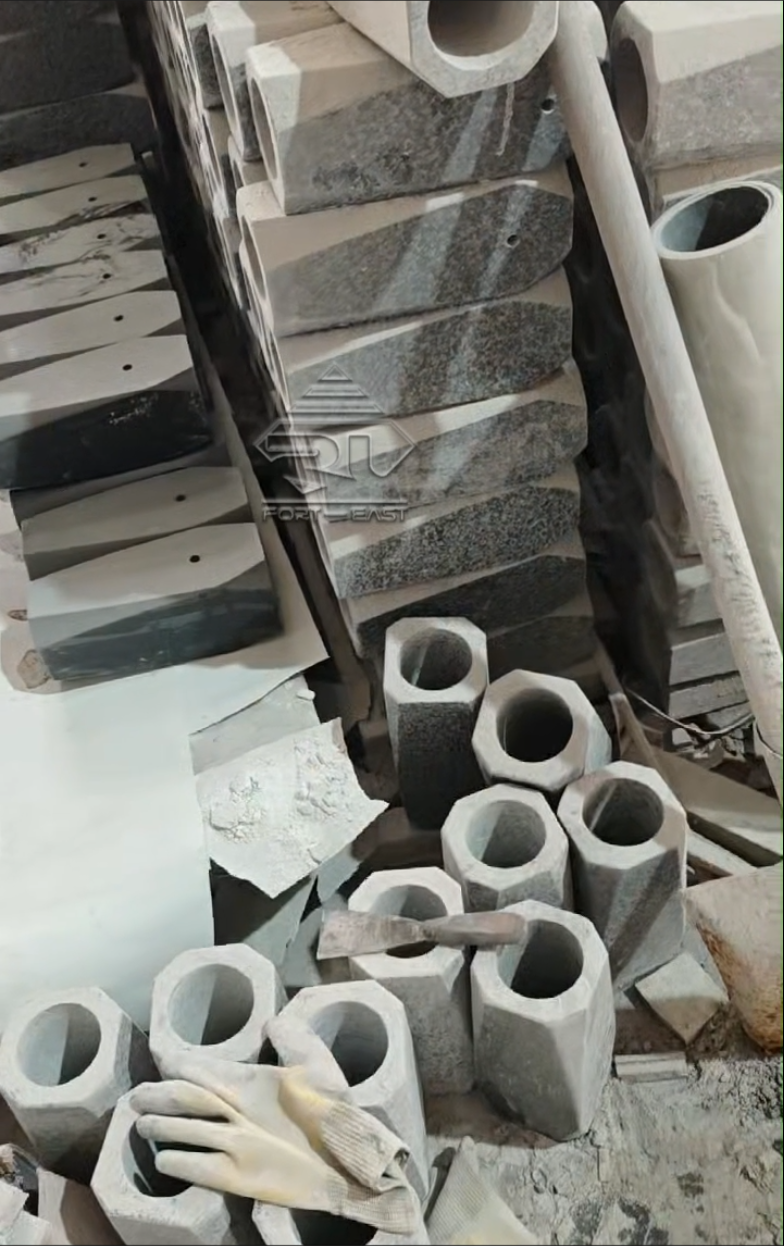
The camera then pans to a storage rack. This rack holds dozens of semi-finished tombstone blanks. These are headstones that have been cut and polished but not yet carved or drilled. From a distance, they look complete. The surfaces shine. The edges are smooth. But the faces are blank. No names. No dates. Each blank tombstone waits for its final instructions. This rack is where a standard tombstone becomes a custom tombstone.
Why keep semi-finished blanks? Because customers need different things. One family wants a traditional monument with a curved top. Another wants a modern headstone with straight edges. Another needs a large grave stone for two names. By keeping polished blanks in common shapes and sizes, we can start carving a new tombstone the same day an order arrives. No waiting for polishing. No delays. That empty tombstone becomes someone's memorial within days. A fast tombstone is not a lower-quality tombstone. It is a smarter tombstone.
The video shows blanks in several colors. Some are dark grey. Some are nearly black. Some have small flecks of lighter mineral running through them. The color changes. The quality does not. Every blank tombstone on this rack has passed the same machine polishing standard. Every blank is ready to become a finished tombstone as soon as a customer says yes. Your next tombstone is probably sitting on this rack right now.
4. Drilling Bottom Holes – Anchoring Every Tombstone to Its Base
The next scene shows a worker at a drilling machine. A polished tombstone lies face down on the workbed. Only the bottom edge is exposed. The worker measures the width of the stone. He marks two or three positions with a wax pencil. Then he pulls the lever. This step determines whether a tombstone stays upright for decades. A fallen tombstone is a failed tombstone. We do not make failed tombstones.
Diamond-tipped drill bits spin down into the granite. Water cools the bits and washes away dust. Within seconds, the holes reach full depth. The bits retract. The worker lifts the headstone and inspects every hole. A tombstone with clean holes will stand straight. A tombstone with bad holes will lean or fall. We only make the first kind of tombstone.
Why is drilling so important? A tombstone must attach to a concrete base. Without clean, straight holes, the monument can tilt or fall over time. Our drilling follows three rules for every tombstone:
Depth control – every hole reaches exactly the planned depth, measured after each tombstone.
Straight entry – holes go straight down, not angled to the side. A crooked hole ruins a tombstone.
Clean rim – no chipping around the top of the hole. A chipped tombstone is an ugly tombstone.
After drilling, the worker uses compressed air to blow every hole clean. Dust inside a hole prevents adhesive from bonding. A dusty hole creates a weak anchor for any tombstone. A clean hole creates a connection that holds the tombstone for generations. A stable tombstone is a respectful tombstone.
The video shows this worker drilling hole after hole. He does not rush. Each grave stone gets the same attention. Each tombstone leaves this station with bottom holes that fit our base pins perfectly. That is how we build a tombstone that lasts. That is how we build a tombstone you can trust.
5. Multiple Workers Packing – Teamwork on Every Tombstone Before Shipment
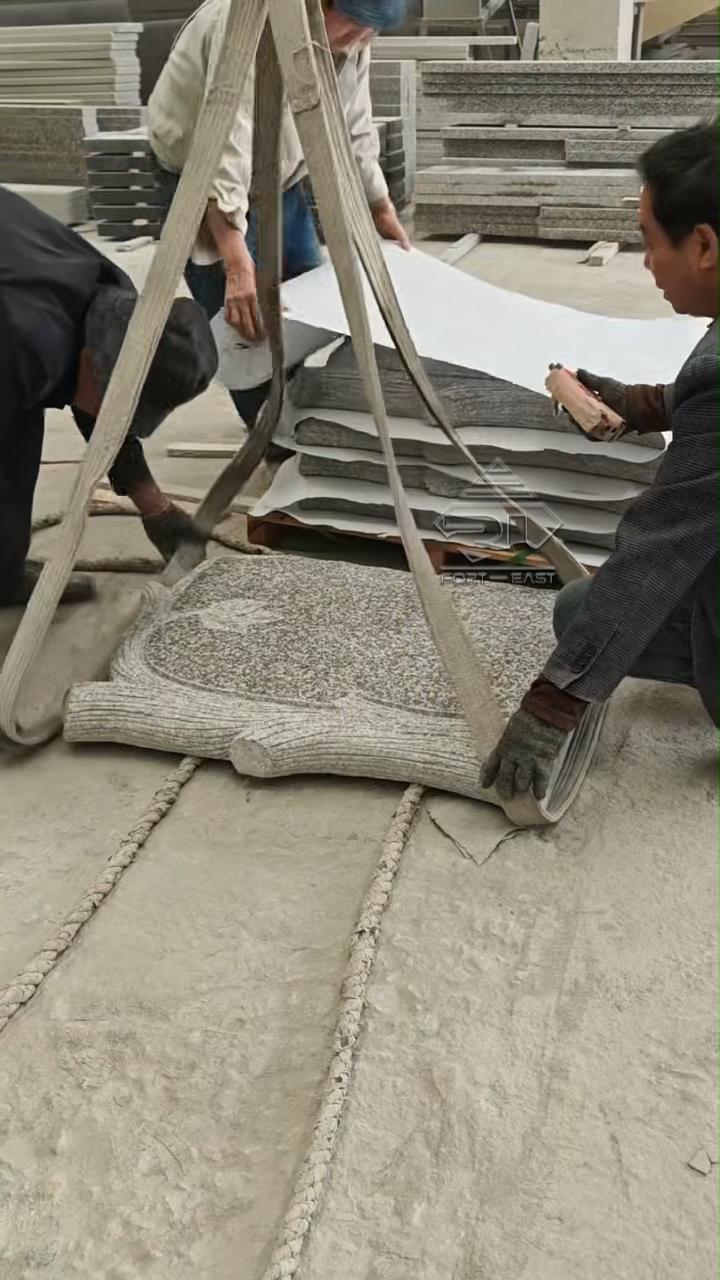
The longest segment of the video shows our packing area. This is not a one-person job. You will see three or four workers gathered around a single tombstone at the same time. Each tombstone receives the same care before shipment. A broken tombstone is a worthless tombstone. Our packing prevents that.
One worker slides foam corner protectors onto the sharp edges of the tombstone. These prevent chipping during transport. A second worker wraps the entire headstone in soft knitted fabric. This fabric sits directly against the polished surface. It does not trap moisture, so no condensation forms against the tombstone inside the shipping container. A dry tombstone arrives as a perfect tombstone.
A third worker adds a layer of corrugated cardboard over the fabric. The cardboard absorbs impacts from bumps on the road. A fourth worker then straps everything to a wooden pallet with steel banding. The banding ratchets tight until the cardboard compresses slightly. A loose tombstone is a dangerous tombstone. Our tombstones are never loose.
For larger grave stones over 200 kilograms, the team adds a full wooden crate. The video shows two workers lifting the crated tombstone with a small forklift. They place it on a shipping rack next to other finished tombstones. Each crate receives a label with handling instructions. "FRAGILE. TOP LOAD ONLY. KEEP DRY." That label follows every tombstone from our door to your cemetery.
Why use multiple workers? Because a heavy tombstone is hard to move alone. One person might drop a corner or scratch a surface. With four people, the tombstone never tips. It never falls. It never touches the floor except on its padded bottom. Teamwork protects every tombstone until it reaches its final destination. A safe tombstone is a delivered tombstone.
Video<< Our Factory+ Tombstone Packing
6. Granite – The Material Behind Every Tombstone We Make
You have read the word granite many times in this article. That is on purpose. Granite is the reason our tombstones last. But a tombstone is only as good as the granite it is made from. We do not cut corners on granite. We do not buy cheap granite for a cheap tombstone. Every tombstone gets the same material standard.
We do not name a specific granite type here. Different customers prefer different colors. Some want black granite for a modern tombstone. Others want grey granite for an older cemetery. Some regions prefer pink or red granite for family monuments. The color is a choice. The quality is not. Every tombstone we make, regardless of color, receives the same polishing, drilling, and packing standards. A black tombstone and a grey tombstone are equal in our factory.
Our granite comes from quarries that meet our density requirement of at least 2.65 grams per cubic centimeter. Softer stones cannot survive our polishing process. Harder stones would cost too much for most families. We choose the middle range – hard enough to last, common enough to afford. That is the balance behind every tombstone we ship. That is the balance behind every tombstone you will receive.
What the Video Shows That Words Cannot
This article describes our process. The video proves it. You will see the factory walkaround with your own eyes. You will watch the machine polishing line turning rough slabs into shiny tombstones. You will see the rack of semi-finished tombstone blanks waiting for your order. You will observe a worker drilling bottom holes into a tombstone with a depth gauge in his hand. And you will watch multiple team members packing a single tombstone as if it carried their own family name.
No voiceover. No fast cuts. Just the real sounds of a working tombstone factory. The sound of polishing pads. The sound of drill bits. The sound of workers talking to each other across a tombstone that will soon stand in a cemetery.
Order a Tombstone From a Factory That Opens Its Doors
Fortune East Stone does not hide behind a brochure. We put cameras on our floor because we believe you should see where your tombstone comes from. Whether you need one headstone for a family grave or a hundred grave stones for a new cemetery, the same standards apply to every tombstone.
Contact us. Watch the video. See your tombstone move through the same polishing, drilling, and packing stations shown above. Your tombstone deserves a factory that welcomes every camera. Your tombstone deserves Fortune East Stone.
About Us
Silvia | Fortune East Stone
📧Email: sales05@fortunestone.cn
📞Phone/Whatsapp: +86 15960363992
🌐Websites: www.fortuneeaststone.com
🌐About Us : https://www.festonegallery.com/
